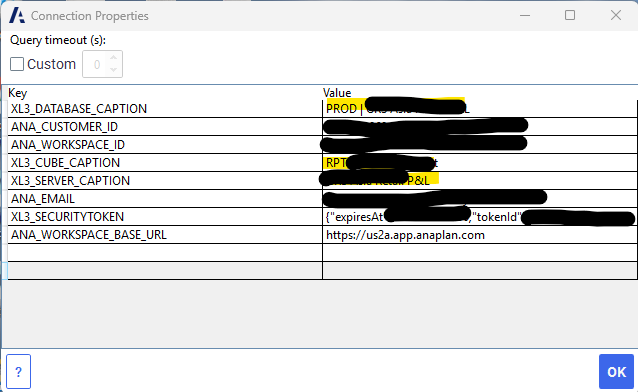
I couldn't find any formula to do this, but I want a way to put on the page/grid the connection details. This is so I know what connection I'm in rather than going into Connections details to see it.
Is there an XL3 formula to return this value?
Hi - If you are using a grid, you can use the Grid title to display the connection. Here is a link to the Anapedia page for more details. If you are connecting to Anaplan as a data source, this is what will be returned: {server} - Tenant\Workspace {database} - Model Name {cube} - Module Name
You can even mix and match the available place holders in the same Title or even layer in other text, such as: Module Name: {cube} from Model: {database} which will display as: Module Name: DATA01 P&L Actual & Budget from Model: L1 Dev Model
Unfortunately, my information doesn't display like that.
My server shows as null. Database shows as a key HEX values and Cube shows as a 12 digit number.
I would like to have the information in the Connection Properties show, in particular the data in the Value fields, highlighted in the attached image.
@Fiorentino check out this video to see if the formula works for you.
Hi everyone 👋 If you build or maintain Anaplan models, you've probably hit the same walls I kept hitting. Some basic questions about a model's structure have no single screen to answer them. You end up clicking through modules and pages one by one, or writing API scripts just to get a list. These were the gaps that…
Hi Everyone, We have a requirement in Anaplan Consolidation & Reporting (Fluence) where the Entity Structure needs to change effective January 2026. The key requirement is that the existing entity structure should continue to be applicable for all reporting and consolidation periods through December 2025, while the new…
We've been building a tool called aplan4sheets and we'd genuinely like input from this community — both on what we've built so far and on what we should prioritize next. The problem we set out to solve: Anaplan's Excel add-in is Windows-centric, and there's no real native way to pivot Anaplan data in Google Sheets. We…