We transitioned from PlanIQ to Forecaster and started importing explainability results into the model. But I’m struggling to interpret some of the since there is no information in Anapedia.
Here are examples from the sales explainability results list:
Historical: trend (ETS, ENSEMBLE)
Historical: linear_trend (ENSEMBLE, PROPHET, MVLR)
Historical: exponential_downwards_trend (MVLR, ENSEMBLE)
Historical: exponential_upwards_trend (MVLR, ENSEMBLE)
Historical: Auto Regressive 1(SARIMAX, ENSEMBLE)
Historical: Auto Regressive 2 (SARIMAX, ENSEMBLE)
Historical: Auto Regressive 3 (SARIMAX, ENSEMBLE)
Historical: Seasonal Auto Regressive 24 (SARIMAX, ENSEMBLE)
Historical: Seasonality_Yearly (MVLR, ENSEMBLE, PROPHET, ETS)
Related: Z__related_data_column lagged 1 month (MVLR, SARIMAX, ENSEMBLE, PROPHET)
Related: related_data_column_4 (MVLR, SARIMAX, ENSEMBLE, PROPHET, TIMESFM)
dayofweek (LIGHTGBM)
dayofmonth (LIGHTGBM)
dayofyear (LIGHTGBM)
distance_from_ts_start (DEEP AR)
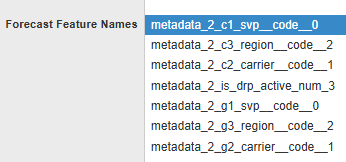
metadata_2_g1_list__code__0 (LIGHTGBM)
Here are my questions:
1. Why are multiple trend types generated (linear, exponential up/down, etc.)?
If exponential_downwards_trend = -0.22 and exponential_upwards_trend = 0.22 for the same item, how should I interpret that? Do they cancel each other?

2. What is the difference between Historical: Auto Regressive 1, Historical: Auto Regressive 2, Historical: Auto Regressive 3, and Historical: Seasonal Auto Regressive 24?
Is Auto Regressive capturing short-term lag memory while Seasonal AR captures longer cycles?
3. I see metadata fields being used in LIGHTGBM.
Anapedia mentions metadata usage for DeepAR. Is metadata also used as categorical features in LightGBM?
4. How does a list item code have an effect in the result? Are they encoded categorically, or could they be interpreted numerically?
Any clarification or official documentation would be helpful.
Seyma Tas


