In as much detail as possible, describe the problem or experience related to your idea. Please provide the context of what you were trying to do and include specific examples or workarounds:
In enterprise planning and forecasting, we aim to produce statistically sound forecasts at multiple organisational levels (e.g. Group, Region, Country, Business Unit) while ensuring that all numbers fully reconcile across the hierarchy.
In practice, the business often defines one level as the anchor—typically the Group forecast—which represents the official target used for steering, communication, and decision‑making. All lower‑level forecasts are expected to align to this anchor while still reflecting local trends, drivers, and realities captured at each level.
The goal is therefore to combine:
- Bottom‑up statistical forecasting at each level
- Top‑down alignment to a defined higher‑level forecast
- Full reconciliation across the hierarchy
Enable forecasting at all organisational levels (e.g. group, region, country, business unit), while ensuring that results remain fully aligned to a defined higher‑level target (typically the Group forecast).
The core logic is that:
- Each level generates its own statistically sound forecast, based on its specific drivers and data.
- A designated anchor level (e.g. Group) defines the target numbers to which all lower‑level forecasts must align.
- Forecasts are then cascaded iteratively and proportionately down the hierarchy, preserving both:
- Top‑down alignment
- Bottom‑up structure and logic
The outcome is consistent numbers across all levels, without sacrificing statistical relevance at lower levels.
1. Fragmented Forecasting Across Levels
Today, forecasting at different levels often happens in isolation:
- Group‑level forecasts are created using aggregated data and high‑level assumptions.
- Regional or country forecasts are built independently using more granular data and local insights.
These forecasts are statistically valid on their own, but they do not automatically align with each other.
As a result:
- Bottom‑up totals rarely match the top‑down Group forecast.
- Alignment requires manual intervention after forecasts are generated.
2. Manual Reconciliation and Spreading
To force alignment, users must rely on manual workarounds, such as:
- Copying Group targets into lower levels
- Applying proportional spreads in Excel‑like logic
- Overwriting statistical outputs with management targets
- Maintaining multiple versions of the same forecast (e.g. “statistical”, “management”, “final”)
These steps are:
- Time‑consuming
- Error‑prone
- Difficult to explain and audit
- Hard to scale across many entities and time periods
Example:
A country produces a statistically driven revenue forecast that reflects a local downturn. At Group level, the overall forecast assumes growth. The country forecast must then be manually “uplifted” to meet the Group target—often by proportional adjustments that dilute the original statistical signal.
3. Loss of Statistical Integrity and Transparency
Because alignment happens after forecasting:
- The final numbers no longer clearly represent a true statistical forecast
- Users cannot easily see:
- What was statistically derived
- What was aligned top‑down
- What was manually overridden
This reduces:
- Trust in the forecast
- Transparency for management
- Explainability of results
4. Lack of Iterative, Bi‑Directional Logic
There is currently no native capability to:
- Iterate between levels (top‑down ↔ bottom‑up)
- Adjust forecasts proportionately while still respecting level‑specific data patterns
- Seamlessly cascade alignment logic down the hierarchy
Instead, each iteration becomes another manual cycle, increasing planning effort and reducing agility.
How often is this impacting your users?
This issue impacts users in every planning and forecasting cycle, including:
- Annual budget
- Forecast updates
- Rolling forecasts
- Scenario simulations
- Management target setting
For large organisations with multiple entities and frequent forecast refreshes, this can mean:
- Repeated weekly or monthly effort
- Significant manual workload during each close‑to‑decision period
- Increased cycle times and delayed insights
Who is this impacting? (ex. model builders, solution architects, partners, admins, integration experts, business/end users, executive-level business users)
Business / End Users (Finance, Actuarial, Planning Teams)
- Spend large amounts of time reconciling and adjusting forecasts instead of analysing drivers
- Lose confidence when numbers change late in the process
- Struggle to explain why forecasts changed between versions
Model Builders
- Must design models that support multiple parallel forecast line items
- Implement workaround logic rather than clean, conceptually sound solutions
- Face increased model complexity and maintenance effort
Solution Architects
- Cannot implement a clean end‑to‑end forecasting design
- Must compensate for missing native hierarchy‑alignment capabilities
- Struggle to future‑proof the architecture
Integration Experts & Admins
- Support additional data flows, reconciliation logic, and validations
- Manage complexity driven by workaround‑heavy designs
Executive‑Level Business Users
- Receive forecasts that reconcile numerically but lack clarity on:
- Where adjustments occurred
- Which levels truly drove the outcome
- Spend time questioning alignment instead of discussing actions
What would your ideal solution be? How would it add value to your current experience?
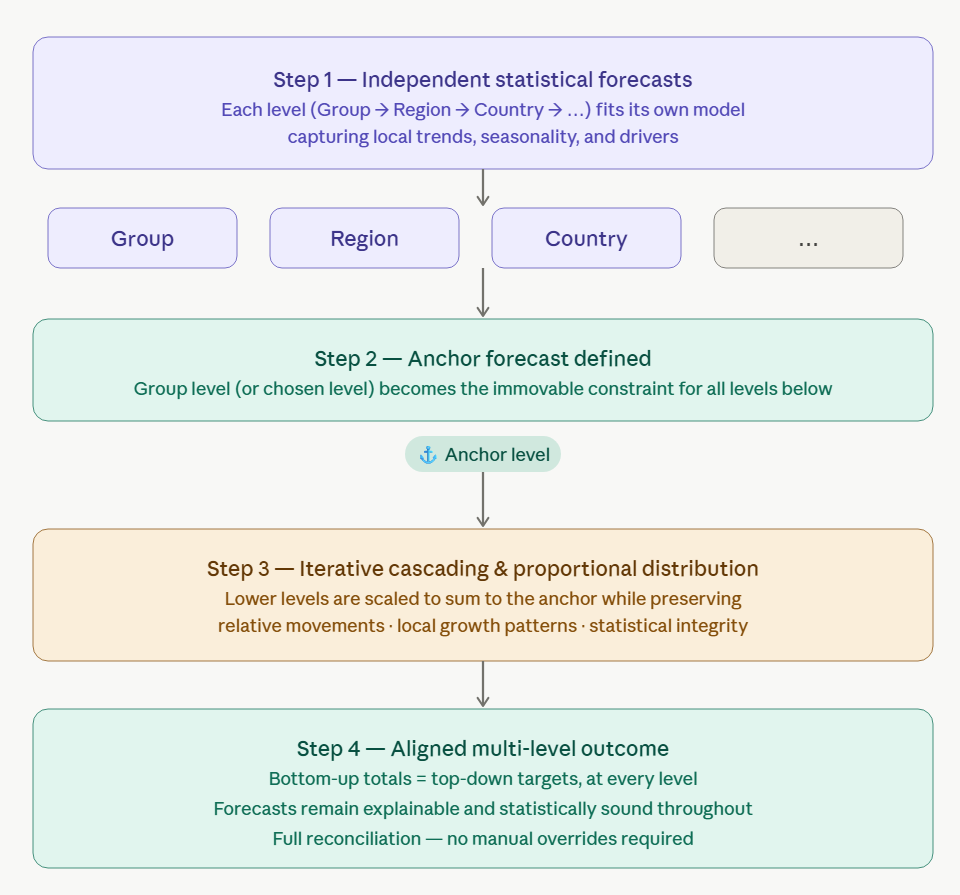
How It Would Work (Conceptually)
- Independent Statistical Forecasts at Each Level
- Each level (Group, Region, Country, etc.) produces a statistical forecast tailored to its own data patterns.
- Forecasts reflect local trends, seasonality, and drivers.
- Definition of the Anchor Forecast
- One level (typically Group) is defined as the alignment reference.
- This forecast acts as the constraint for all lower‑level forecasts.
- Iterative Cascading & Proportional Distribution
- Lower‑level forecasts are scaled proportionately to align with the anchor level, while preserving:
- Relative movements
- Local growth/decline patterns
- Statistical integrity at that level
- Aligned Multi‑Level Outcome
- Numbers reconcile perfectly:
- Bottom‑up totals = top‑down targets
- Forecasts remain explainable at every level.
Achieve a fully aligned, multi‑level forecasting framework where each level is statistically forecasted, but all numbers reconcile automatically to a defined higher‑level forecast.
Please include any images to help illustrate your experience.