Author: Kndia Davis is a Certified Master Anaplanner with five years architecting scalable Anaplan models.
Dynamic allocation order is a foundational requirement across many industries, whether you’re distributing inventory, assigning capacity, or prioritizing financial allocations. In most Anaplan models, this allocation order is traditionally hard-coded. While that approach works initially, it quickly becomes difficult to maintain. Any shift in business logic — new products, revised prioritization rules, changing demand patterns — requires manual updates to the calculation chain.
The challenge is straightforward in concept — we need a way to allocate values based on a sequence, while dynamically calculating both:
- what has already been allocated, and
- what still needs to be allocated
However, executing this logic in a flexible, scalable way, without hard-coding the order, requires careful design.
In this ‘How I Built It’, I’ll walk through how I built a fully dynamic allocation engine that adjusts automatically to business-defined ordering rules. You’ll see how to structure lists, mapping modules, and cumulative logic to support a repeatable, auditable allocation process without hidden dependencies or maintenance overhead.
Concept overview
For this walkthrough, I’m using a simple illustrative example: each month, we input two values — expected available production and additional required material for consumption. In a real operational model, these numbers would typically be calculated rather than manually entered. They might come from inventory target logic, production capacity constraints, utilization assumptions, or downstream demand plans. But keeping the inputs simple helps focus on the allocation mechanics.
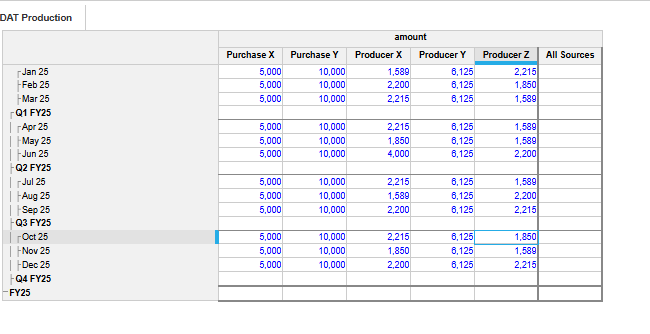

In this example, the allocation order — the sequence in which consumption draws from production — is set manually. This keeps the demonstration easy to follow, but in a production model the order could be calculated dynamically, often using a combination of RANK, FINDITEM, or other list-driven logic. This ensures the model adapts when new products, periods, or business rules change.

How I Built It
The key to building this dynamic calculation is using native Anaplan Versions. Including Versions allows us to perform rolling or cumulative calculations over a list, in a similar way to how we calculate over Time periods.
Because native Versions have several limitations, the build uses two elements:
- a Priority list that is tied to the assignments, allowing for real time updates to allocation order, and
- a Version-based priority that the calculation actually runs against.
To connect the two, the Version priority must be manually linked to the corresponding Priority list item, either via an import action or manual entry. This mapping lets the model use Versions to perform the cumulative logic while still aligning with the business-defined allocation order. Additionally, if you need to manage priority by time, time simply needs to be added to the input modules and the two priority mapping module (list based and version based).

‘How I Built It’ video
The allocation logic also calculates any unconsumed production, which becomes the starting point for future-period inventory projections. To ensure those amounts flow cleanly through the subsequent calculations, the last priority item must be flagged as the current version. This provides a stable reference that the model can use to identify which portion of production remains available for later period allocations.

My example is simple to focus on the technical design, but the same principles can be used other use cases. Here are a few examples:
- Allocating limited inventory across multiple sales channels.
A business may need to distribute available stock to wholesale, e-commerce, and retail channels based on service-level goals or strategic importance. Higher-priority channels receive inventory first, and any remaining quantity flows to the next channel in the sequence.
- Assigning shared labor capacity across projects or departments.
When several teams draw from a common labor pool, available hours must be distributed in a specific order. For example, urgent projects before routine operations. As priorities shift, the allocation order can be updated without restructuring the logic.
I hope you find my tutorial helpful. Leave a comment with questions!